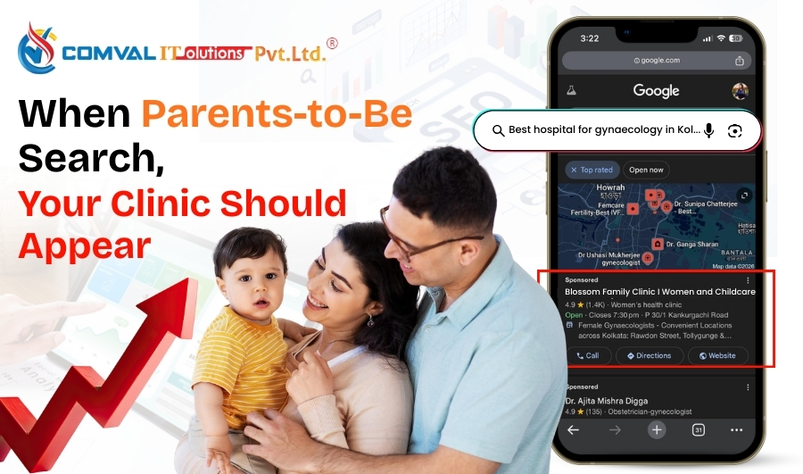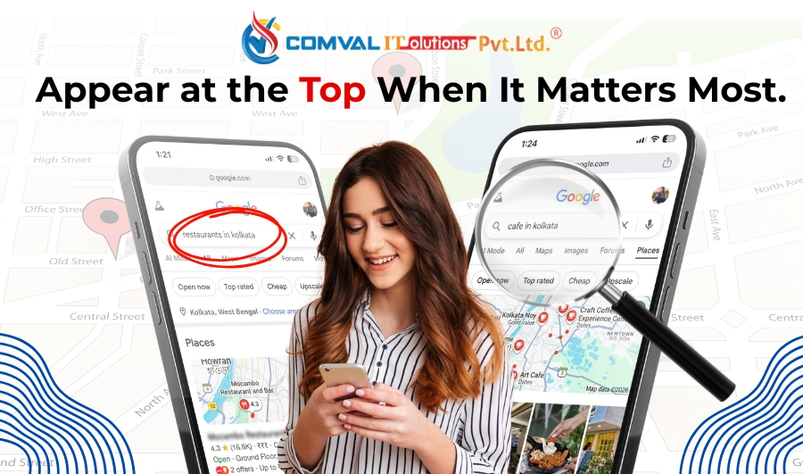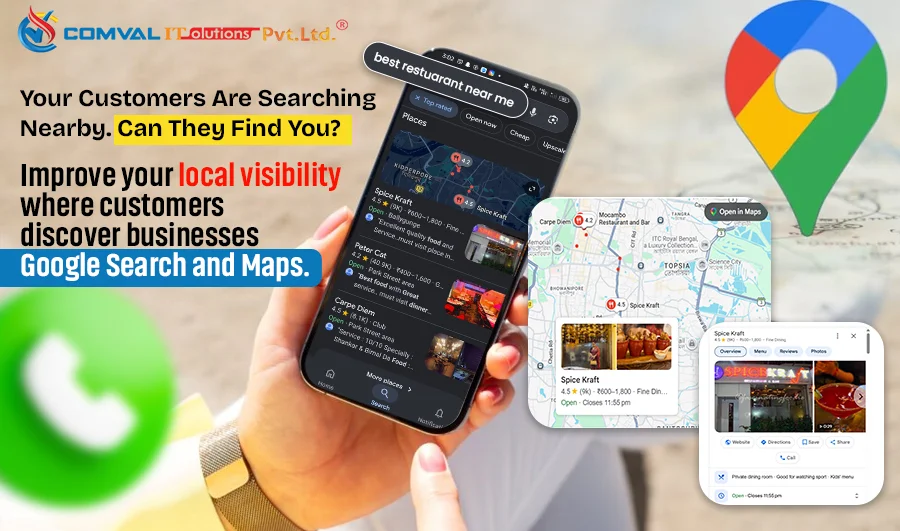
Imagine a customer in Kolkata searching for “best dental clinic near me” or “restaurant open now.”
Within seconds, Google may display nearby businesses with their locations, customer reviews, opening hours, photos, and contact options.
The customer can compare businesses and choose one without visiting multiple websites.
Now imagine that your business offers exactly what the customer needs, but your competitor appears in the local search results instead.
Why does this happen?
Your business may have incomplete Google Business Profile information, an outdated website, unclear service details, or a weaker local online presence.
As we approach 2027, local SEO is becoming increasingly important for businesses that depend on customers within a particular city, neighbourhood, or service area.
People are not just searching for businesses. They are looking for convenient, reliable solutions close to them.
This is where local search optimization helps.
Local SEO is the process of improving a business’s online presence so nearby customers can discover it through relevant searches, particularly on Google Search and Google Maps.
In this guide, we will explain how local SEO works, what affects Google Maps visibility, how AI-powered search is changing customer discovery, and what businesses can do to attract more relevant local enquiries.
What Is Local SEO and Why Does It Matter in 2027?
Local Search Engine Optimization (Local SEO) focuses on helping businesses become more discoverable when customers search for products or services in a specific geographic area.
Unlike broader SEO campaigns that may target national or international audiences, local SEO focuses on searches connected to a particular location.
For example:
- Digital marketing company in Kolkata
- Dental clinic in Salt Lake
- Restaurants near New Town
- Real estate agency near me
- AC repair services in Howrah
- Website development company in Kolkata
These searches often indicate that someone is looking for a business they can contact, visit, or compare.
A person searching for “what is dental cleaning?” may be researching a topic.
Someone searching for “dental clinic near me” may be looking for a nearby provider.
Both searches are important, but the second may be closer to a business enquiry or appointment.
This is why local SEO can be valuable for businesses that serve customers within particular locations.
The objective is not only to attract website traffic. It is to help relevant customers discover the business and take the next step.
How Do Customers Find Local Businesses on Google?
Local discovery can happen through several Google experiences.
When people search for a local service, Google may show regular website results alongside a local business section containing relevant listings.
The results can vary depending on the search query, location, device, and other factors.
Google Maps allows users to explore businesses geographically.
Customers may compare nearby options, read reviews, check opening hours, or request directions.
For businesses with a physical location, this can be an important discovery channel.
A Google Business Profile is the business information listing that can appear in Google Search and Maps.
It can display useful details such as:
- Business name and category
- Location or eligible service area
- Operating hours
- Contact details
- Website link
- Products or services
- Photos
- Customer reviews
A complete and accurate profile makes it easier for potential customers to understand what a business offers.
Businesses that need professional support can explore Google Business Profile optimization and management services from Comval IT Solutions.
Why Do Competitors Appear Above Your Business in Local Search?
One of the most common questions business owners ask is:
“Why is my competitor showing on Google Maps while my business is not?”
There is no single explanation.
Google’s local search systems consider different signals to determine which businesses are relevant to a search.
According to Google’s official local ranking guidance, local results are mainly influenced by three factors.
Relevance refers to how closely a business matches what someone is searching for.
Imagine a person searching for “website development services in Kolkata.”
A business with accurate category information, clearly described services, and relevant website content is easier for Google to understand than one with vague business information.
Businesses should select appropriate Google Business Profile categories and provide clear descriptions of the services they genuinely offer.
The primary category should describe the business’s main activity, not simply the keyword it wants to rank for.
Distance refers to how far a business is from the location associated with the search.
A customer in Salt Lake and another customer in Behala may see different businesses for the same query.
That does not necessarily mean one business has a better overall SEO strategy.
Location matters.
Businesses cannot control where every potential customer searches from, but they can provide accurate location and service-area information.
Prominence relates to how well-known or established a business is.
Google considers signals such as online information, links, and reviews when assessing business prominence.
This is one reason businesses should focus on genuine customer experiences, trustworthy information, and a credible online presence.
However, there is no method that guarantees a particular Google Maps position.
Understanding the Three Factors
| Ranking factor | What it means | What businesses can improve |
|---|---|---|
| Relevance | How well the business matches the search | Accurate categories, services and business information |
| Distance | How far the business is from the search location | Correct location and service-area information |
| Prominence | How established or well-known the business is | Genuine reviews, business reputation and relevant online presence |
Understanding these factors helps business owners approach local SEO more realistically.
Google Business Profile Optimization : Your First Step Toward Better Local Visibility
A Google Business Profile is one of the most important online assets for an eligible local business.
However, creating a profile is only the beginning.
Businesses must also keep their information accurate, useful, and updated.
Your primary category should represent what your business actually does.
For example, a restaurant should select an appropriate restaurant category, while a marketing agency should select a category that best describes its main services.
Additional categories may be helpful when they accurately represent other services.
Avoid adding unrelated categories simply to target more keywords.
Review the business name, address, phone number, website, and opening hours.
A customer who calls an outdated number or visits a business during incorrect opening hours may lose confidence.
For service-area businesses, provide information according to Google’s eligibility and address-display guidelines.
Do not use false addresses or virtual offices to create artificial locations.
A service business should clearly explain what it provides.
For example, a digital marketing company might list services such as search engine optimization, social media marketing, and website development when those services are genuinely available.
Service information helps potential customers understand whether the business is relevant to their needs.
Images can help people evaluate a business before contacting it.
A restaurant might share dining-area and food photographs.
A clinic could display its reception area, where appropriate and compliant with privacy requirements.
A design agency might showcase its workplace or approved project examples.
Use genuine, high-quality visuals that accurately represent the business.
Review changes to business information, special hours, services, and other relevant details.
Google may also suggest certain business information updates, so profile owners should monitor their listings for accuracy.
Consistent Google Business Profile management helps reduce outdated information and creates a better experience for customers.
Before choosing a local business, many customers want to understand what other people experienced.
Reviews can provide useful insight into service quality, communication, professionalism, and customer satisfaction.
For example, someone comparing two restaurants may look beyond the average rating and read recent customer experiences.
They may want to know whether the food is consistent, the staff is helpful, or the restaurant is suitable for families.
The best approach is to request honest feedback from real customers after genuine interactions.
Google allows businesses to share review links and QR codes to make leaving feedback easier.
However, businesses must not offer rewards or discounts in exchange for reviews, purchase fake reviews, or selectively request only positive feedback.
Businesses should also pay attention to their review responses.
A thoughtful response to a positive review shows appreciation.
A calm, professional response to a negative review shows that the business takes customer concerns seriously.
Review management should focus on genuine feedback and customer trust rather than manufacturing a perfect rating.
Google provides detailed guidance on getting and responding to reviews.
Google Maps SEO: Why Your Website Still Matters
Some businesses assume that having a Google Business Profile means they no longer need a well-optimized website.
That is not the case.
Your profile can help customers discover your business, while your website can provide the detailed information needed to make a decision.
For example, a person looking for an interior designer may discover a business through Google Maps.
Before contacting the company, they might visit its website to review completed projects, services, work processes, and contact information.
If the website is confusing or difficult to use, the customer may leave.
A local SEO strategy should therefore connect business profile management with website optimization.
Each important service should have a useful page that explains what the business offers, who it serves, and how customers can get started.
Avoid creating pages that only repeat keywords without providing meaningful information.
Location-specific pages can be useful when businesses genuinely serve different geographic markets.
For example, a company serving customers across Kolkata might explain its service coverage, local customer needs, and relevant project experience.
However, creating dozens of nearly identical pages for different neighbourhoods is not a good long-term strategy.
Each page should provide information that is genuinely valuable to the target audience.
Customers frequently use smartphones when looking for nearby businesses.
Your website should make it easy to read service information, access contact details, and complete an enquiry.
Clear navigation, fast-loading pages, and easy-to-use contact forms support that experience.
Connect related pages so visitors can easily explore your services.
For example, a business reading about local search may also benefit from understanding broader SEO services, website optimization, or content marketing.
These connections help users discover information without navigating through unrelated pages.
How AI-Powered Search Is Changing Local Business Discovery
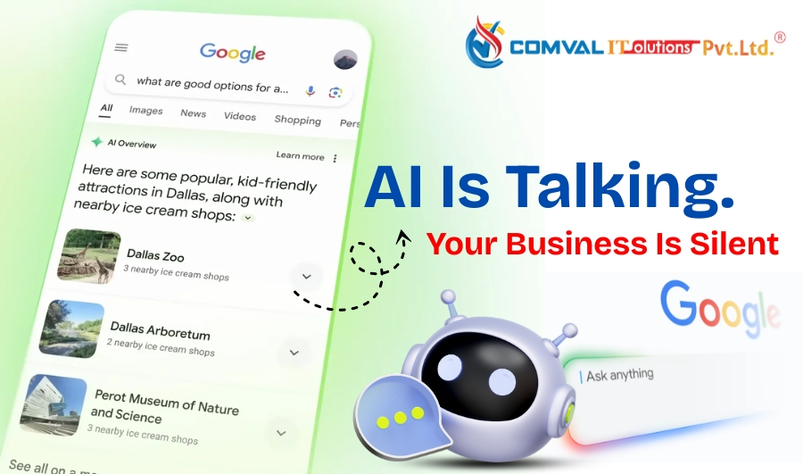
Artificial intelligence is becoming part of the broader search experience.
Google AI Overviews and AI Mode can help users research questions, compare options, and explore supporting sources.
This introduces additional ways for customers to research local products and services.
For example, a customer might ask:
“Which factors should I consider when choosing a dental clinic in Kolkata?”
Instead of searching only for individual clinics, the customer may first read an AI-assisted explanation of what matters.
They could then explore local business results, websites, and customer reviews.
The practical lesson is that businesses should make their information clear, accurate, and helpful.
This includes maintaining:
- Accurate Google Business Profile details
- Useful service descriptions
- Well-structured website content
- Genuine reviews
- Clear location information
- Helpful answers to customer questions
Google’s guidance on AI features in Search explains that existing SEO best practices remain relevant for AI Overviews and AI Mode.
There is no special markup or shortcut that guarantees inclusion.
AI-powered local discovery creates another reason to maintain trustworthy information, not a reason to abandon traditional local SEO.
Local Search Rankings Are Important, but Customer Actions Matter More
Ranking higher can improve opportunities for visibility, but it should not be the only way businesses evaluate their local SEO campaigns.
Consider two situations.
Business A: Appears frequently in local searches but receives few relevant enquiries.
Business B: Receives fewer profile views but generates more appointment requests and qualified enquiries.
Which business has the stronger outcome?
The answer depends on the business objective, customer quality, and actual results.
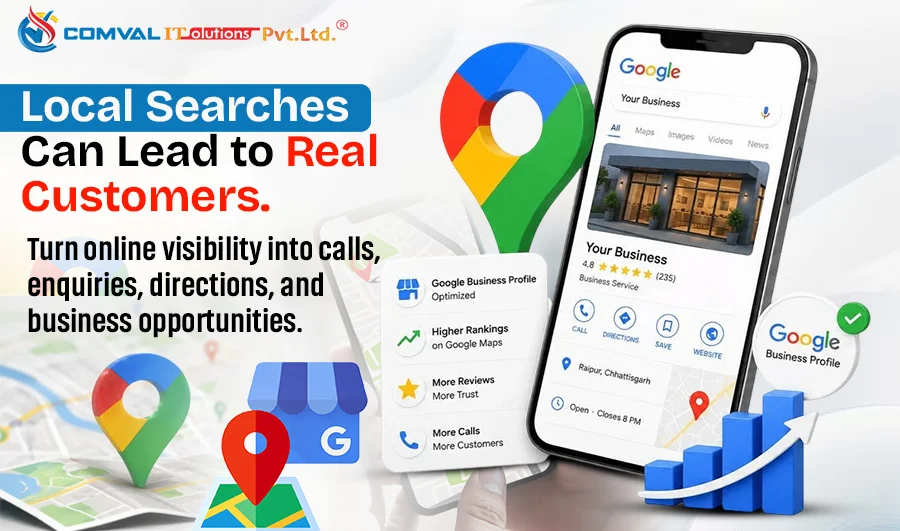
This is why local marketing should connect discovery with measurable customer actions.
Important Local SEO Performance Metrics
| Metric | What it helps measure |
|---|---|
| Google Business Profile views | How often people view the profile |
| Search queries | The searches associated with profile discovery |
| Call clicks | How often customers select the call button |
| Direction requests | Interest in navigating to the business |
| Website clicks | Visits initiated from the business profile |
| Enquiry forms | Website visitors contacting the business |
| Bookings | Completed appointments or reservations, when tracked |
| Qualified leads | Enquiries relevant to the business's services |
Google Business Profile Performance provides several of these interaction metrics.
However, a call-button click does not necessarily mean that a phone conversation took place, and a direction request does not confirm a completed visit.
Businesses should combine profile metrics with website analytics, call records, booking systems, and CRM information when available.
The objective is to understand whether online visibility is contributing to genuine customer opportunities.
A Practical Local SEO Example: A Healthcare Clinic in Kolkata
Imagine a healthcare clinic operating in Salt Lake, Kolkata.
The clinic provides legitimate services and has an experienced team, but its website receives limited local traffic.
Its Google Business Profile contains basic information, although some service details and photographs are missing.
Nearby competitors have more complete listings and clearer websites.
The clinic decides to improve its local search presence.
The clinic verifies its operating hours, contact details, location, and appropriate business categories.
It adds clear information about available services and appointment options.
The clinic creates useful pages explaining its services, appointment process, facilities, and answers to common patient questions.
The content focuses on helping patients understand the clinic rather than repeatedly inserting location keywords.
After appropriate patient interactions, the clinic offers customers a neutral way to leave honest feedback.
It responds professionally while protecting patient privacy.
The website makes the appointment process easier to understand.
Visitors can find contact details and relevant service information without unnecessary steps.
The clinic reviews profile views, website clicks, enquiry submissions, and completed bookings.
It compares these outcomes over time rather than relying only on Google Maps rankings.
This is a hypothetical example, not a real case study or guaranteed outcome.
It demonstrates how local SEO combines accurate information, website usability, trust, and measurement.
The same process can be adapted for restaurants, educational institutions, real estate agencies, retail businesses, and other local service providers.
Local SEO Checklist: How to Prepare Your Business for 2027
Businesses do not need to make complicated changes all at once.
Start with the fundamentals.
- Claim and verify your eligible Google Business Profile.
- Select relevant business categories.
- Confirm accurate contact details, location, and opening hours.
- Add services, photos, and appropriate business information.
- Monitor profile updates and customer feedback.
- Create informative pages for important services.
- Improve mobile usability and navigation.
- Use relevant location information where useful.
- Add clear contact and enquiry options.
- Check indexing and technical website issues.
- Encourage genuine customer reviews.
- Respond appropriately to feedback.
- Maintain accurate business information across important platforms.
- Publish relevant business information and real examples.
- Review Google Business Profile Performance.
- Monitor relevant website traffic.
- Track enquiries and customer actions where possible.
- Compare visibility across relevant search locations.
- Update information when services, hours, or business details change.
This checklist provides a practical foundation for businesses preparing for new developments in local search.
Common Local SEO Mistakes Businesses Should Avoid
Even businesses with good products and services can experience limited local visibility because of avoidable problems.
- Inaccurate Business Information - Incorrect contact details or opening hours can inconvenience potential customers and weaken trust.
- Irrelevant Business Categories - Selecting categories simply because they contain popular keywords can make the profile less accurate.
- Fake or Incentivized Reviews - Manipulated reviews violate Google's policies and can lead to restrictions.
- Creating Duplicate Listings - Businesses should not create unnecessary duplicate profiles or fake branches to target additional locations.
- Publishing Thin Location Pages - Changing only the city name across multiple identical website pages provides little value.
- Ignoring Website Experience - A business may attract potential customers through Google Maps but lose them through a poor website experience.
- Tracking Only Rankings - Ranking reports are useful, but they should be evaluated alongside calls, enquiries, bookings, and other business outcomes.
Avoiding these mistakes can help businesses build a more credible and sustainable local search presence.
How Can Local SEO Services Help Small Businesses?
Managing local visibility requires more than updating a business listing once.
Businesses may need help reviewing profile information, improving website content, researching local keywords, monitoring competitors, and tracking performance.
Professional local SEO services can help create a structured approach to these activities.
A local SEO plan may include:
Local Search Research: Understanding how potential customers search for services in relevant locations.
Google Business Profile Management: Maintaining accurate and useful business information.
Website Optimization: Improving service pages, mobile usability, headings, and local relevance.
Review Management Guidance: Building a compliant process for requesting and responding to genuine feedback.
Competitor Analysis: Reviewing the visible local search landscape without copying competitors or using misleading tactics.
Performance Reporting: Monitoring relevant local searches, profile interactions, website traffic, and enquiries.
Businesses can explore Comval IT Solutions’ local SEO services and packages to understand available service options.