Running advertisements on Facebook and Instagram has become easier, but getting meaningful business results is still a challenge.
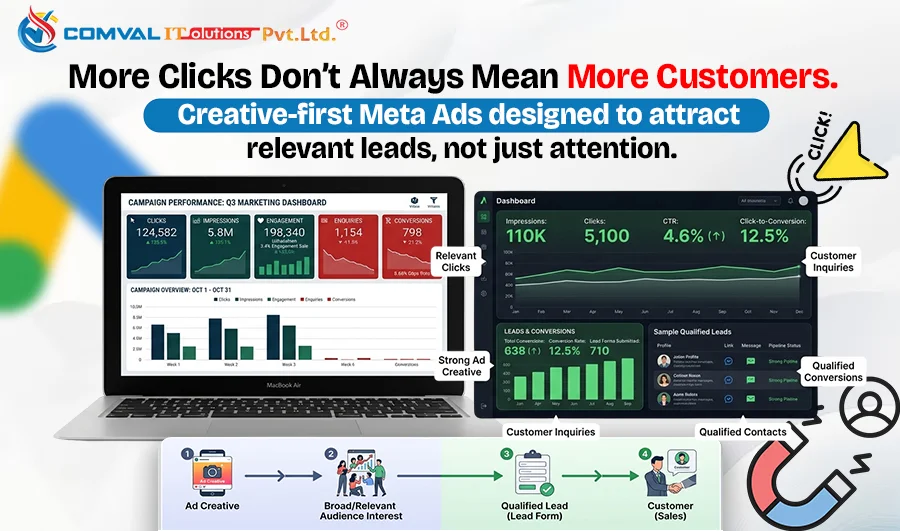
A business may spend money on advertisements, receive hundreds of clicks, and still struggle to generate genuine customer enquiries. Another business may get fewer clicks but attract people who are ready to book an appointment, request a quotation, or make a purchase.
So, what makes the difference?
It is not always the advertising budget or the number of people who see the ad. Often, the difference comes down to the campaign strategy, creative message, customer understanding, and how results are measured.
As we approach 2027, Meta advertising is becoming increasingly supported by artificial intelligence. AI-powered tools can help advertisers discover potential audiences, optimize ad delivery, and test creative variations.
However, automation cannot completely replace human understanding of customers and business goals.
The most important lesson for businesses is simple: successful Meta advertising is not about generating more clicks. It is about attracting the right customers and creating measurable business opportunities.
In this guide, we explain how Meta Ads work, how artificial intelligence is changing advertising, why creative testing matters, and how businesses can prepare a smarter Meta Ads strategy for 2027.
What Are Meta Ads and How Do They Work?
Meta Ads are paid advertisements that businesses create through Meta’s advertising tools to reach audiences across supported platforms, including Facebook, Instagram, Messenger, and other available placements.
Businesses use these advertisements to promote products, services, offers, events, and brand messages.
Unlike organic social media posts, paid advertisements allow businesses to set objectives, control advertising budgets, and reach audiences beyond their existing followers.
For example, a clothing brand might advertise its latest collection on Instagram. A healthcare clinic could promote appointment booking information on Facebook, subject to applicable advertising policies. A real estate company might advertise a property project to generate enquiries from interested buyers.
Meta provides different advertising objectives depending on what a business wants to achieve.
Common objectives include:
- Awareness: Introducing a business, brand, or product to potential customers.
- Traffic: Encouraging people to visit a website or landing page.
- Engagement: Generating interactions with content or conversations.
- Leads: Encouraging potential customers to submit enquiries, complete forms, or contact a business.
- Sales: Promoting purchases and other valuable conversion actions.
- App promotion: Encouraging relevant users to install or engage with an application.
Choosing the right objective matters because Meta’s advertising system uses it to determine which actions to optimize for.
For example, a campaign optimized for website traffic may generate visitors, but those visitors will not necessarily become customers.
If your main goal is to generate enquiries, your campaign should be planned around that outcome.
How Is AI Changing Meta Advertising in 2027?
Artificial intelligence is already playing an important role in digital advertising.
Meta uses machine-learning systems to analyze advertising signals, predict user responses, and determine how advertisements are delivered.
During 2026, Meta continued investing in AI-driven advertising tools, including improvements to creative generation, ad ranking, campaign recommendations, and automation.
According to Meta’s 2026 advertising update, the company has continued developing systems intended to make campaign setup more efficient and improve advertising performance.
These changes are important when businesses prepare their campaigns for 2027.
AI tools can assist advertisers in developing and adapting creative assets.
Depending on the tools available, these features may support image variations, creative adjustments, or other production tasks.
However, generated content still needs human review.
A creative asset may look attractive but fail to explain the product, communicate the offer, or reflect the brand correctly.
AI-assisted systems can analyze campaign information and suggest improvements.
These recommendations may help advertisers identify potential optimization opportunities, but they should be evaluated against actual business goals.
A recommendation that increases engagement may not be useful if the company primarily wants qualified sales enquiries.
The key point: AI can support advertising decisions, but businesses still need a clear understanding of what they want their campaigns to achieve.
What Is Meta Advantage+?
Meta Advantage+ refers to a collection of AI-powered advertising features designed to automate or assist with different parts of campaign management. Businesses may encounter Advantage+ tools when setting up targeting, placements, budgets, creative assets, or certain campaign types.
The specific options available depend on the advertising objective, account, location, and current platform capabilities.
Advantage+ Audience uses advertiser inputs and Meta’s AI systems to help identify potential customers.
Instead of relying exclusively on narrow interest-based targeting, advertisers can provide useful audience information while allowing the system flexibility within applicable controls.
This can be helpful when a business wants to reach new customers but does not know every interest or behavior associated with its ideal audience.
Advantage+ Placements can distribute advertisements across eligible placements rather than requiring advertisers to manually select every placement.
This allows Meta’s system to consider different opportunities for reaching campaign objectives.
Businesses should still review where their advertisements appear and ensure their creative assets work across relevant formats.
Advantage+ Creative can assist with creative optimization and available enhancements.
These tools may help adapt creative assets for different placements or presentation opportunities.
However, automation does not eliminate the need for strong original images, videos, messaging, and offers.
Not necessarily in exactly the same way.
Meta Advantage+ can be useful, but the right setup depends on campaign objectives, available conversion data, budget, creative assets, and business requirements.
For example, an ecommerce store with reliable purchase tracking may approach automation differently from a newly established B2B company generating its first enquiries.
A sensible strategy is to test available automation features while monitoring business outcomes.
Why Creative Testing Matters More Than Simply Changing Targeting
Imagine advertising the same product with three different messages.
The first advertisement focuses on price.
The second explains how the product solves a customer problem.
The third demonstrates the product through a short video.
All three advertisements may reach similar audiences, but they communicate different reasons to take action.
This is why creative testing is an important part of modern Meta advertising.
Your creative is not simply the picture or video used in an advertisement. It includes the complete message that someone experiences.
Important creative elements include:
- The opening headline or video hook
- The image or video
- The customer problem being addressed
- The product or service benefit
- The offer or value proposition
- Trust-building information
- The call to action
What Should Businesses Test?
Different hooks: Test whether users respond better to a question, a clear benefit, or a problem-solving message.
Different formats: Compare appropriate static images, videos, Reels, carousels, and other supported formats.
Different messaging angles: Explore messages focused on convenience, expertise, quality, value, or a specific customer need.
Different offers: Where commercially appropriate, test consultations, product demonstrations, quotations, or genuine promotional offers.
Different calls to action: Compare actions such as “Learn More,” “Get a Quote,” or “Book a Consultation” where supported.
Avoid changing everything at once without a clear testing plan. Otherwise, it becomes difficult to understand what caused a performance difference.
A strong Facebook Ads strategy should test meaningful differences in advertising messages rather than producing many nearly identical creative variations.
Why AI Cannot Fix a Weak Advertising Offer
One common mistake businesses make is assuming that advanced targeting or automation will automatically improve results.
But what happens if the advertisement does not give customers a convincing reason to respond?
Consider two website development advertisements.
Advertisement A: “We Build Websites. Contact Us Today.”
Advertisement B: “Planning a Business Website? Explore Responsive Design, SEO-Ready Structure, and a Clear Development Process.”
The second message provides more information about what the customer can expect.
It may be more useful to someone actively comparing website development providers.
This does not guarantee better results, but it shows why the offer and message matter.
Before running a campaign, businesses should answer:
- What problem does our service solve?
- Who is most likely to need it?
- What makes our offer relevant?
- Why should someone trust our business?
- What happens after a user clicks the advertisement?
- Is the next step clear and easy?
Meta’s automation can help deliver advertisements, but it cannot automatically make an unclear or unsuitable offer attractive.
Clicks vs Leads vs Customers: What Should Businesses Measure?
One of the most important parts of Meta Ads optimization is understanding the difference between attention and business results.
An advertisement can receive thousands of impressions and hundreds of clicks without producing many valuable enquiries.
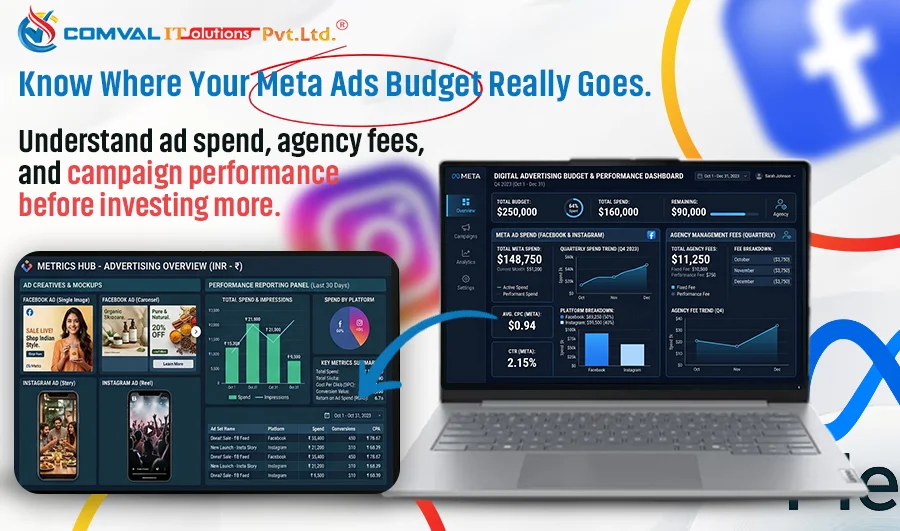
To evaluate campaign performance, businesses should understand several metrics.
| Metric | What It Measures | Why It Matter |
|---|---|---|
| Impressions | Total times an ad is displayed | Indicates advertising exposure |
| Reach | Number of people reached | Helps measure audience coverage |
| CTR | Percentage of impressions resulting in clicks | Indicates response to the advertisement |
| CPC | Average cost per click | Helps assess traffic acquisition cost |
| CPL | Cost per recorded lead | Measures the cost of generating enquiries |
| Qualified CPL | Cost per qualified lead | Focuses on potentially valuable enquiries |
| CPA | Cost per defined acquisition or conversion | Measures cost against a chosen outcome |
| ROAS | Revenue attributed to ads divided by ad spend | Helps evaluate advertising return |
A high click-through rate can be encouraging, but it does not automatically mean a campaign is profitable.
Similarly, a low cost per lead may look attractive while hiding poor lead quality.
A Practical Example: Why Fewer Clicks Can Produce Better Results
Imagine a restaurant in Kolkata running two Facebook and Instagram advertising campaigns.
The restaurant wants more table reservations.
The first campaign uses a general food photograph with a message encouraging people to explore the restaurant.
It receives considerable engagement, but many users are only browsing.
The restaurant receives clicks and reactions, but relatively few reservation enquiries.
The second campaign promotes a genuine weekend dining experience.
The advertisement clearly explains the offer, shows the restaurant environment, identifies the location, and includes a reservation action.
It may receive fewer clicks, but the people who respond may have stronger booking intent.
The answer depends on the business objective and actual results.
If the objective is table reservations, the restaurant should compare completed bookings, booking value, advertising cost, and customer acquisition cost.
Campaign A may still contribute to brand awareness, but Campaign B may be more relevant to immediate reservation goals.
This is a hypothetical example, not a claim about actual campaign results.
It demonstrates an important principle
The best-performing advertisement is not necessarily the one with the most attention. It is the one that delivers the most relevant results for the business objective.
Which Businesses Can Benefit from Meta Ads?
Meta advertising can support different types of businesses, provided campaigns are tailored to their audiences and goals.
Small businesses: Promote services, generate local awareness, and encourage enquiries.
Restaurants and cafés: Highlight dining experiences, reservations, genuine offers, and events.
Ecommerce brands: Showcase products, encourage purchases, and evaluate return on advertising spend.
Real estate companies: Present property information and generate relevant enquiries while complying with applicable housing advertising rules.
Healthcare providers: Share appropriate service and appointment information while following healthcare-related advertising policies and privacy requirements.
Education businesses: Promote courses, events, and relevant admissions information.
B2B companies: Introduce professional services, build awareness, and encourage consultation requests.
Each industry needs different messages, creative formats, conversion goals, and performance expectations.
How Comval IT Solutions Approaches Meta Advertising
AI-powered advertising tools can assist with campaign management, but businesses still need a strategy that connects customer needs, creative communication, and measurable outcomes.
Comval IT Solutions provides digital marketing services to help businesses plan and manage their Facebook and Instagram advertising activities.
A structured approach can include
Campaign Strategy: Understanding business objectives, customers, services, locations, and advertising opportunities.
Creative Planning: Developing advertising messages, images, videos, and calls to action around relevant customer needs.
Campaign Setup: Selecting suitable objectives, budgets, placements, and campaign settings.
Tracking and Measurement: Reviewing available conversion events, enquiry sources, and performance information.
Campaign Optimization: Evaluating creative performance, campaign delivery, advertising costs, and lead quality.
Performance Reporting: Helping businesses understand what their advertising investment is producing and where improvements may be needed.
With creative strategy, appropriate AI-supported tools, and ongoing performance analysis, businesses can make better-informed advertising decisions.
The objective is not simply to spend more on Meta Ads. It is to use advertising more effectively.